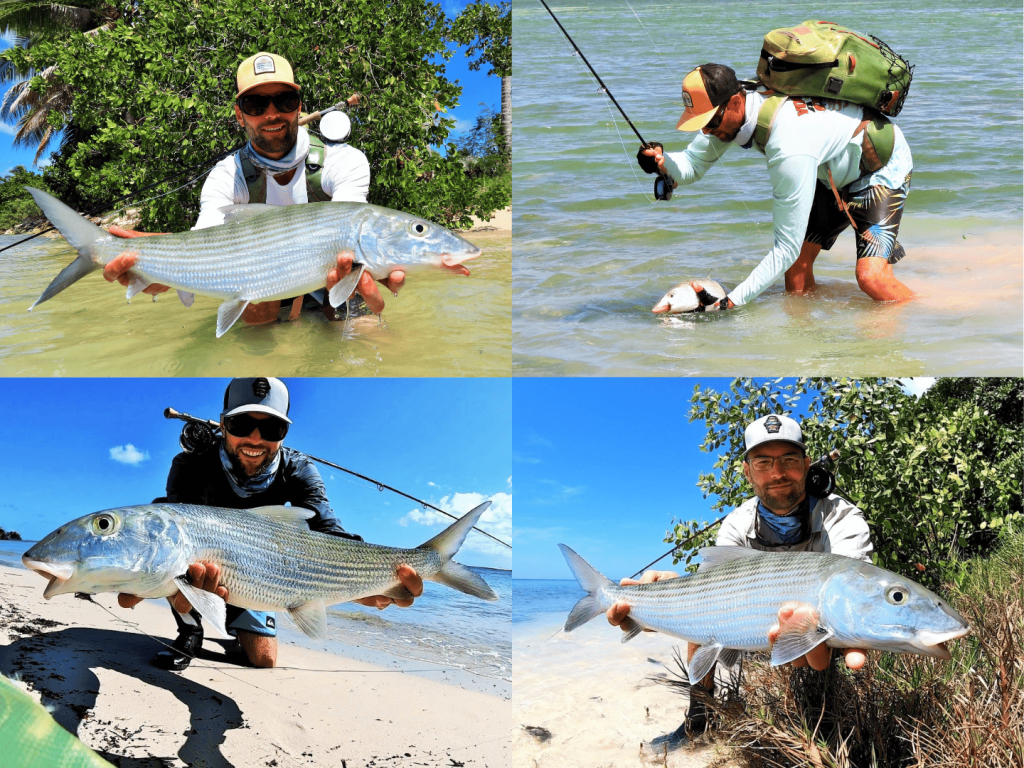



Bonefish (albula vulpes) are found throughout the Caribbean.
From the long beaches of Mexico to the immense flats of the Bahamas, from the Florida Keys to Belize and Venezuela, it is also very present in the waters of the Lesser Antilles and of course on the islands of the sublime Guadeloupe archipelago (French West Indies).
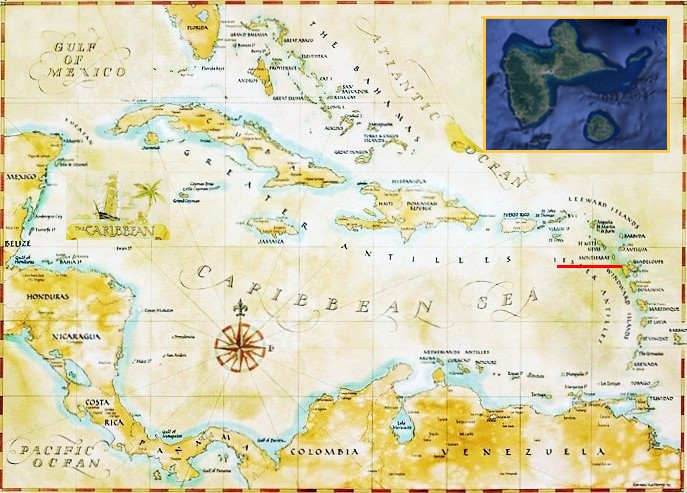
I acquired all my knowledge of this fish thanks to sight fly fishing on the flats of the « Butterfly Island », where I’ve been fishing since 2012 and guiding since 2016.
Since offering my services as a professional fishing guide, I have spent hundreds of hours walking the flats, accompanying or not, honing my approach, my observation skills, my fishing « strategies », as well as my general knowledge about this fabulous sport fish.
A little history :
The very first bonefish were fished specifically with flies in the 1920s. This means that this great sport fish has been sought after for almost 100 years. Initially caught accidentally while snook or baby tarpon fishing, it was in the 1940s that passionate fishing guides from the Florida Keys really began to track it on sight and on fly.

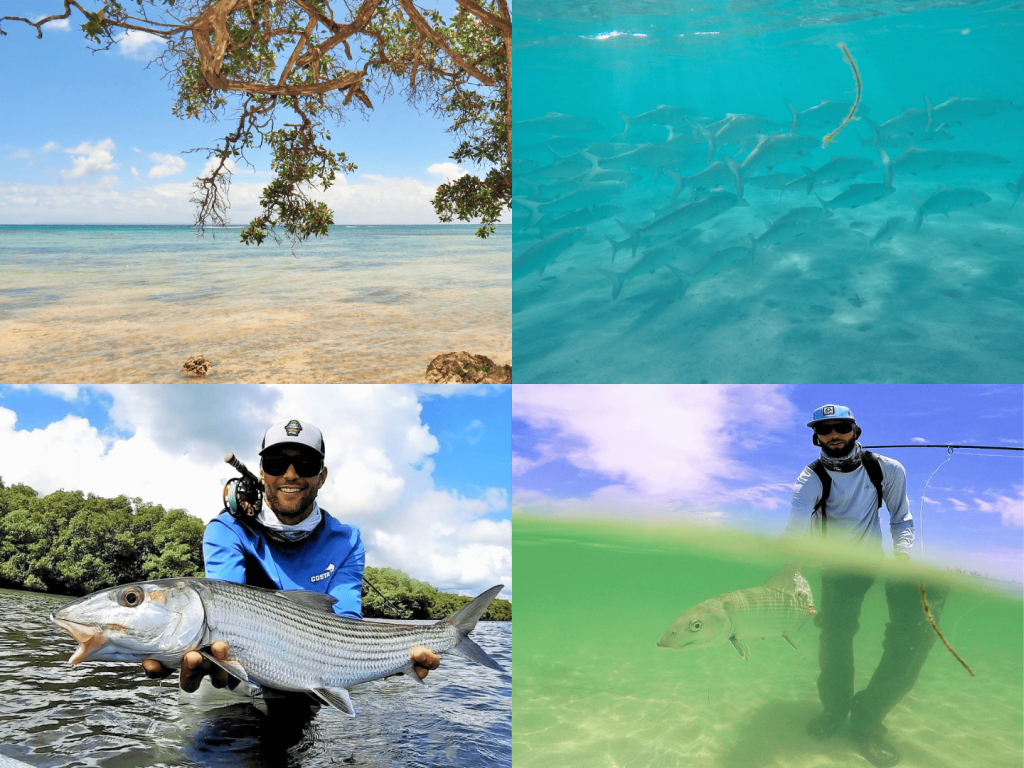
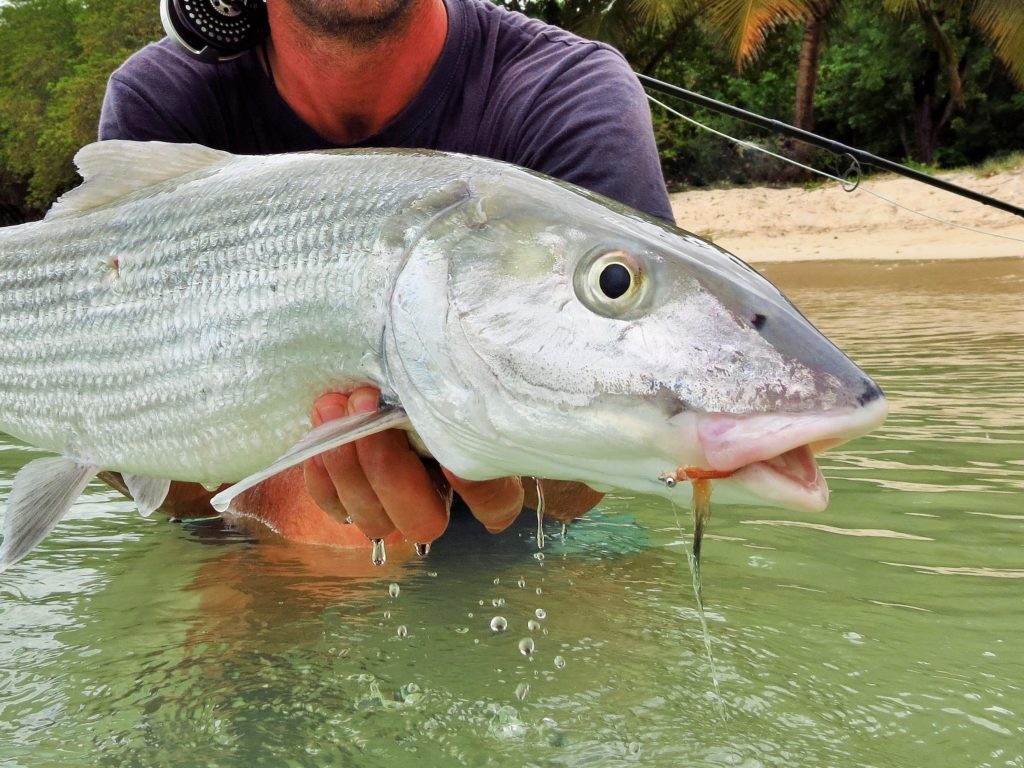
Big bonefish caught on sight and on fly in Guadeloupe.
Lefty Kreh , Lee Wulff, Jimmie Albright, Stu Apte, Homer Rhode Jr, Bill Smith, Charlie Smith, Ted McVay, Rupert Leadon, Billy Pate are just some of the legendary names who have left their mark on the history of bonefish fishing.
In Guadeloupe, the first to offer their services as guides on the flats were Alexis Ducros, and Matthieu Gentilhomme (he had previously been an “auxiliary guide” for a decade with my father’s organization in the early 2000s on Alaskan salmon rivers). These French fishing guides contributed to the development of sight-fishing for bonefish on the fly, respecting the ethics of guiding and the American approach. In other words, guides accompany their clients, without fishing, while respecting the environment in which they work. In real time, he provides the advice necessary for each angler’s progress, helping to catch mythical fish such as the “ghost of the flats”.
Without necessarily being fully aware of it, these two guides in particular were the pioneers of inshore sport fishing in Guadeloupe. Before 2005, very few sport fishermen had tried to catch bonefish, snook, tarpon or permit in French West Indies waters. Compared to the USA, for example, in Guadeloupe in 2025 we are still in the infancy of coastal sport fishing.
Why on fly and why on sight ?
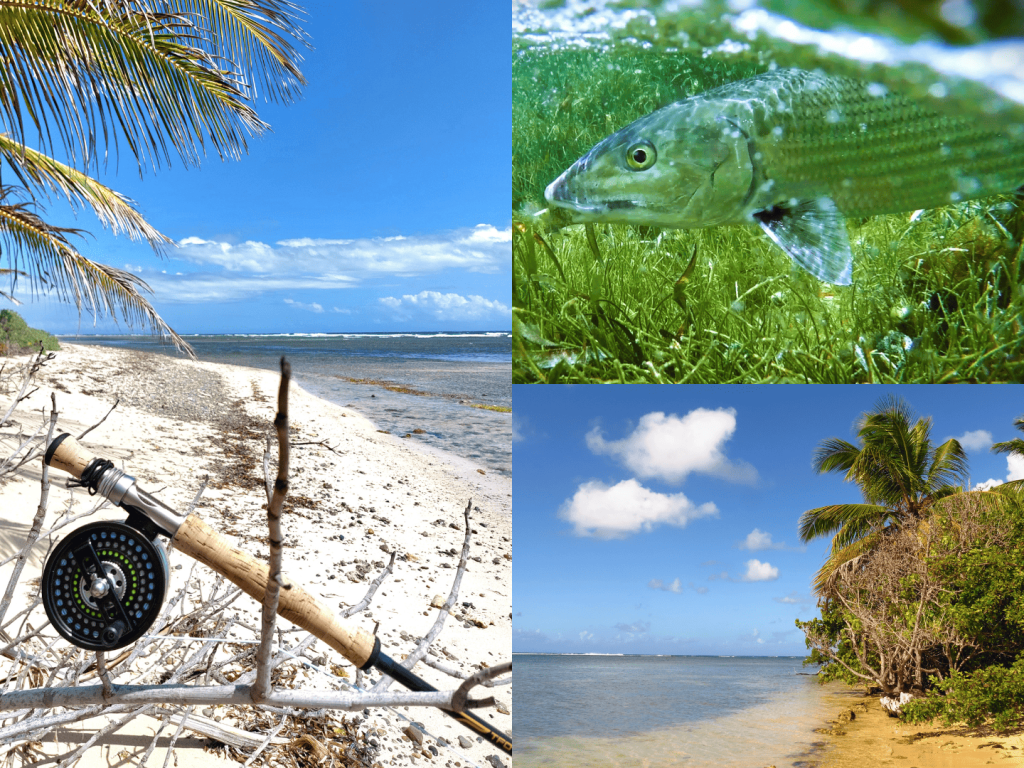
Two species are particularly present on the flats of Guadeloupe, bonefish and permit (trachinotus falcatus). They also live in deeper environments. They are fished with lures and natural bait in this type of biotope. At one time, bonefish were even used as bait for deep-sea pelagic fish such as marlin…
The fly fisherman takes advantage of its presence in skinny water to fish it specifically « on sight » by « wading ». Under these circumstances, there’s no doubt that a single bonefish or a school of fish will not hesitate to return to the depths if it feels insecure.
Sport-fishing aficionados who have tried the various fishing techniques that define this appellation today (lure fishing or catch-and-release fly-fishing) know just how thrilling the sight-fishing approach can be, by trying to spot the fish before attacking it ! No other approach provides such pleasure and sensations !
While I enjoy fishing with lures as much as with flies (not bonefish and permit !), this approach has to remain « sporting », by which I mean in a way where ethics are scrupulously respected.
Having said that, I can assure you that when fishing in very shallow waters, sometimes less than twenty centimetres (7,88 inches), the fly-fishing technique is formidable.
It’s easy to understand, for example, that a hard or soft lure, however light it may be, will always be heavier than a fly. And when it comes to discretion, which is highly recommended for catching big bonefish on foot on the flats, if you go by the simple parameter of efficiency, the fly will win out in most situations !
In my opinion, any angler who is a little in tune with his sensations will feel an intense pleasure in experiencing these unique moments ! That’s why the bonefish is one of the most sought-after sport fish species on the planet. What’s more, the bonefish is quite simply the 7th fastest fish in the sea.
It was this fish that introduced me to tropical fishing and led me to specialize in sight fishing. It’s one of the most fun, fine and exciting fisheries I know, and that’s why I love sharing my knowledge of this species so much.
Strategy :
The day before each outing, I check the weather conditions. In other words, the amount of sunshine, which will help me choose the flats where I’ll have the best visibility. A flat lined entirely with seaweed, and therefore very dark, is best fished on a clear, sunny day. On the other hand, if clouds are forecast, I’ll prefer areas with more sand. And that’s not all. We all know that yesterday’s forecast is not always tomorrow’s reality. So you have to be able to adapt in real time, and quickly estimate what decision to make. To stay or to go, that’s the question that always comes up.
I also find out about wind direction and speed. The orientation of the flats varies, and their height of water changes according to the strength and direction of the wind. If you imagine a bay with no wind at high tide, it will have a height of water almost equivalent to that of the same bay at mid-tide, or even at low tide with an incoming wind.
With experience, you’ll be able to make the right choices at the right time.
Approach:
Each time I accompany a new angler, I make a point of listing the main parameters for sight-fishing bonefish. They can be summed up in 3 steps :
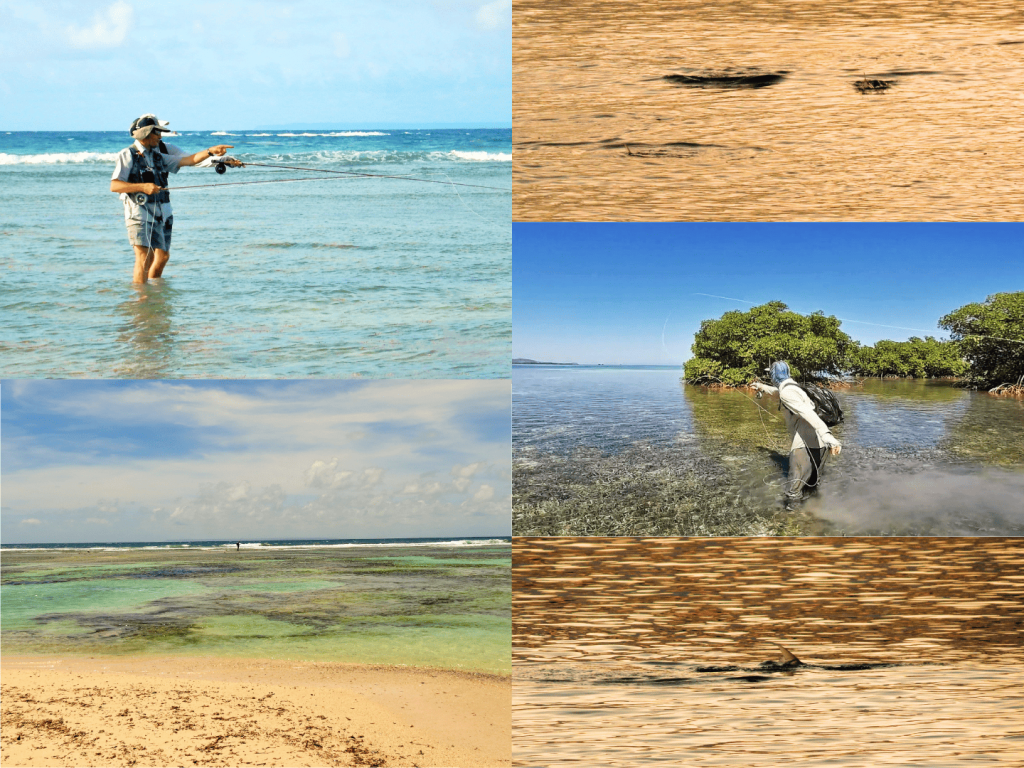
Firstly, visualize the fish, secondly, position yourself in relation to the fish’s trajectory, and thirdly, offer your fly as discreetly as possible…
Let’s go back over 3 fundamental points.
First of all, spotting.

Bonefishes can be found in large schools (in Guadeloupe, seeing fifteen bonefishes together is already a lot) or solitary. Only once or twice in 10 years of intensive fishing on the archipelago have I seen close to 100 individuals grouped together on the same flat. Most of the time, we encounter small groups of 5 to 10 bonefishes. Larger fish often swim alone or in smaller groups of 2 or 3. Bonefishes are fish with a perfect mimicry, their skin adapting perfectly to the color of the bottom on which they have just spent the last few minutes. This is their way of escaping predators such as osprey in the air or barracudas and sharks below the surface. This rapid mimicry makes them all the more difficult to see. Occasionally, their fins protrude from the surface, a process known as tailing. This occurs either when the depth is such that the fish’s back and tail protrude from the surface, or when they are searching the bottom for prey, head down.

These tailings are easy to spot by any slightly observant angler. However, only in 5-10% of situations will you encounter a bonefish tailing. In fact, they very often intercept their prey between 2 waters. So it’s essential to spot them below the surface, otherwise you’ll miss out on most of your opportunities !
When on the flats, they spend much of their time searching for food, mainly shrimps and crabs. On « coral » flats, bones move from prey to prey and are moving the vast majority of the time. This means that once you’ve spotted a fish, in many cases you’ll only have a few seconds to offer it your fly before it changes direction, overtakes you or « guesses » you !
You need to get in front of him as quickly as possible and cast. A minimum of false casts is preferable to avoid casting too much shadow on the water.
We attack them from an average distance of 10-15 meters (33-50 feet). Sometimes even less. So you don’t need to be a top-class caster to succeed with an accompanied angler. Once you’ve spotted the bone, its behavior will determine whether you should wait for it to come to you or go after it, depending on its swimming speed. In any case, you’ll need to make a quick decision before he disappears…
It’s better to cast a little short than too long, otherwise he’ll see your line and either go or not bite. The depth and the bulkiness of the bottom determine the distance at which bones are able to see their prey. Leave about one to two rod lengths between the fish’s head and your fly. When attacking a school of several individuals, be sure to spot the first one closest to you. If you scare the first one, the following bones are likely to be scared too. With these small groups, mostly made up of beautiful specimens approaching and/or exceeding 60cm (23,52 inches), the phenomenon of food competition is almost non-existent. You should therefore proceed as if you were attacking an individual, and succeed, if possible, on the first attempt !
Your fly is in the water, and if the bottom is sandy, you can let it sink to the bottom and wait for it to come on top before starting to animate. If, however, the bottom is shallow and strewn with turtle grass, you’ll need to « strip ». The speed of the strip will vary according to the swimming speed of the fish. When guiding, I advise you to listen carefully and simply follow the instructions. Although I always try to explain what behavior a bonefish is capable of, there are many different situations. The more different situations you encounter, the faster you’ll progress and be able to do the right thing at the right time.
If the bonefish is interested, it will start following your fly, more or less quickly. Once again, you’ll need to adapt the strip’s speed…
The fight :
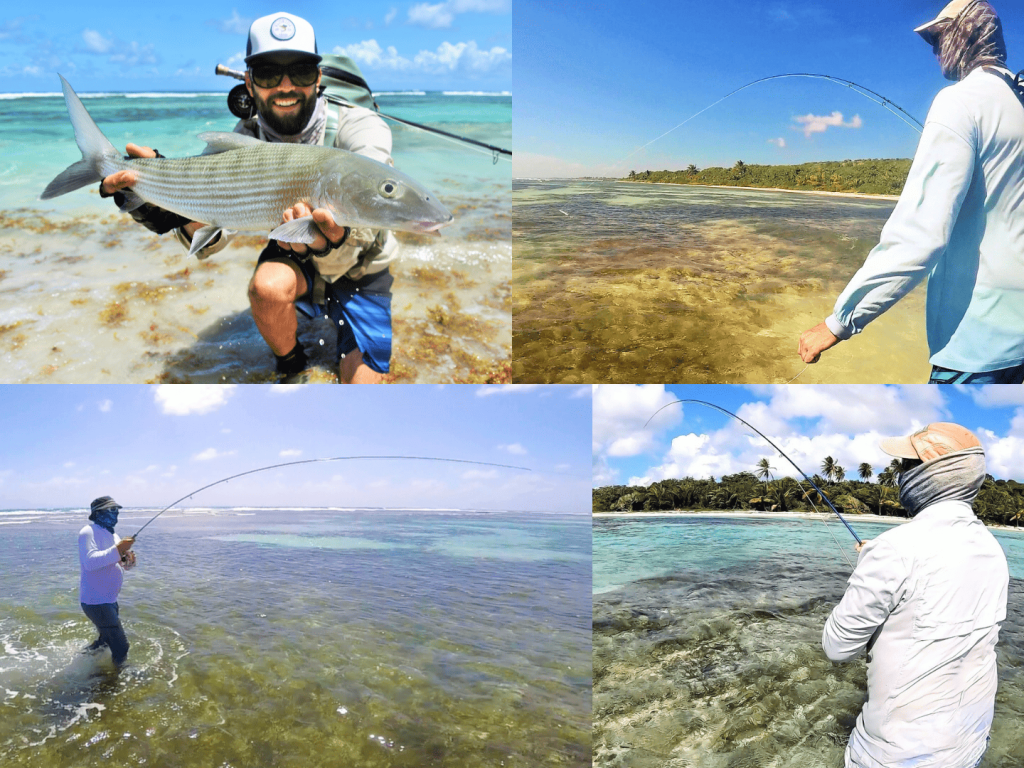
The fish has taken, the strike is successful. In other words, you have tensioned your line with the hand opposite to the one holding your rod. A successful bonefish strike is no more and no less than a strong strip. If he doesn’t take well, keep stripping until you stop him dead in his tracks. In most cases, he’ll perform an explosive rush, sometimes interminable with the big ones ! Bonefish are formidable fighters, powerful, incredibly fast and enduring ! Sometimes you have to go with them, sometimes you have to restrain them. To begin with, let the fly line slide between your fingers, maintaining gentle pressure. Too much pressure at this speed and it’s guaranteed to break ! Keep the line away from your reel and rod butt, otherwise the free line will get tangled in them ! Try to keep tension when the fish comes back to you and keep the rod high to avoid the line rubbing on the often abrasive bottom.
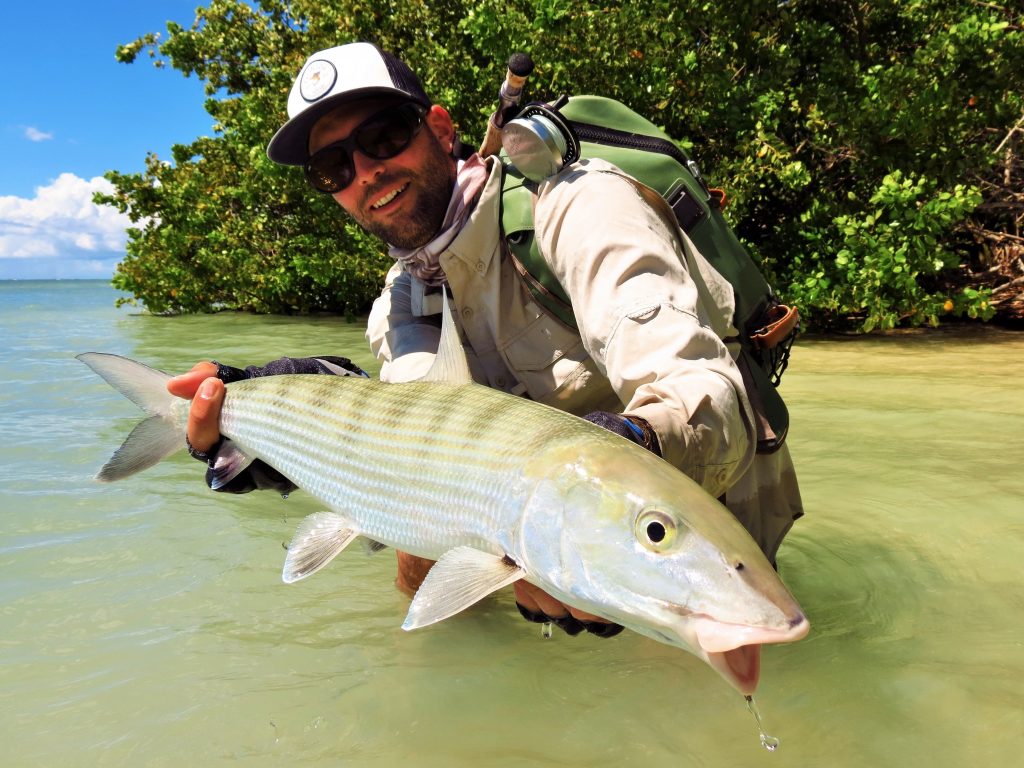
Once you’re within reach, it’s best to grab the bonefish with soaked hands. Never ground it completely on the sand or rocks ! Its skin is very fragile, and if the mucus that protects it is removed, it will leave its skin bare and therefore open to fungus and other parasites. Keep it in the water as much as possible ! As with all fish that put up a long, intense fight, it will need to recover by breathing, and that means in the water, of course… Hold it firmly by the tail with one hand and the other under its belly. Be careful never to put your fingers in its gills, as this is the most important visible vital organ in fish !
The release:
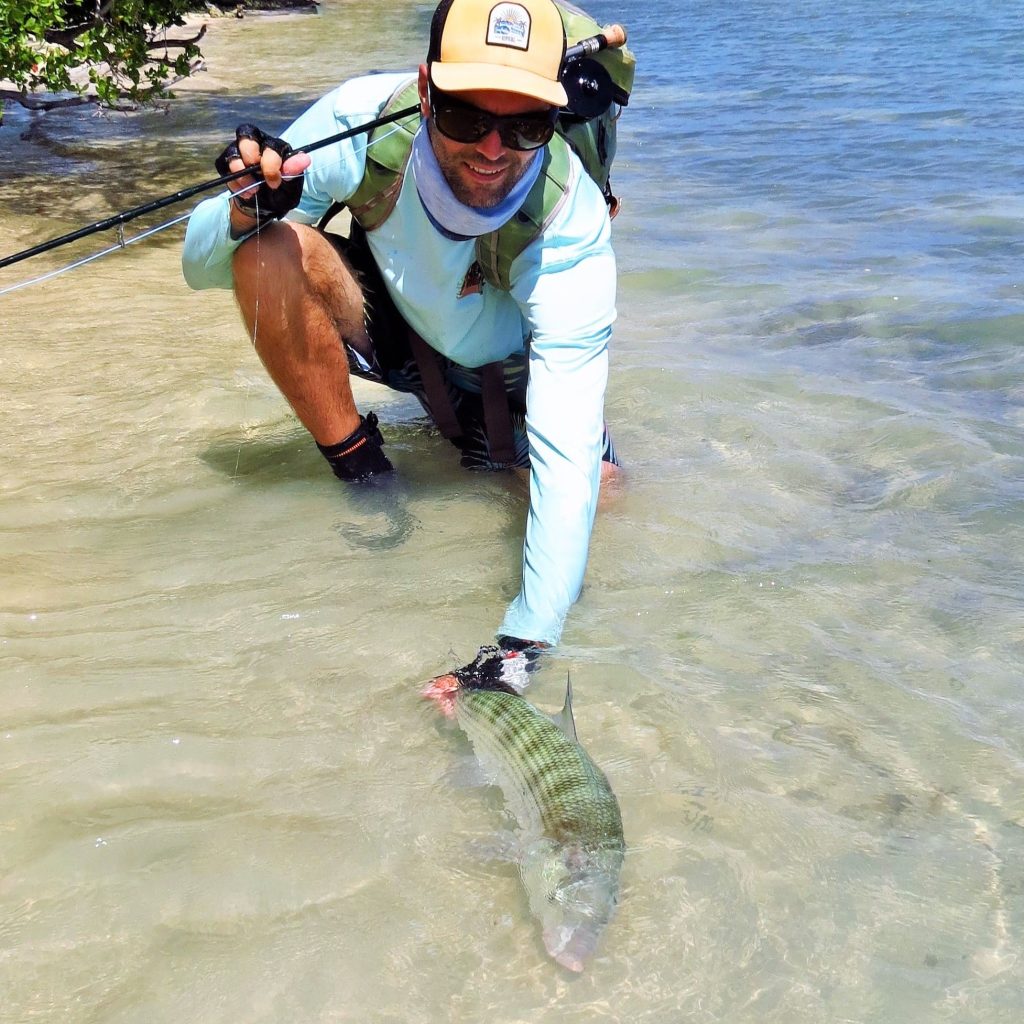
If you see the fish regularly taking in water, it means it has regained its shape. It’s ready to go again. If the fish hardly opens its mouth, don’t take it out of the water again – it’s “choking”! Hold the fish horizontally, with its back to the sky, and let it swim away uninterrupted.
Congratulations, you’ve just caught your first bonefish on sight, on the fly 😉!
The fishing tackles :
As far as tackle is concerned, it’s pretty much the same as for bass fishing in France for example. However, there are a few variations in terms of the strength of the components, which make up the ideal set for bonefish fishing, especially for larger fish, the local average is between 55 and 60cm (21 – 23,52 inches), with specimens of over 70cm (27,56 inches) being relatively common !
Reel :
A 9 line reel with a heavy-duty drag is preferable. The flats here are dotted with turtle grass and the coral reef or coral potatoes are never far away. Fights are therefore intense and often end in breakage if the drag is of too poor quality, or not designed for this type of fish with explosive rushes, or is simply not adjusted properly. For those globetrotting bonefish anglers who have visited the various countries where this species is found, please don’t compare the endless sand flats to those of France, where obstacles are omnipresent…
For the fight, which is therefore powerful, I recommend a good quality reel and drag. The rod is not the most important tool in a fight. In little water, the fish will go horizontal, and bending the rod with all your might won’t slow down a big bonefish! Knowing how to set your reel brake precisely is, in my opinion, the most important parameter to master !
If you’re not sure whether to buy a good-quality reel or a good-quality rod, I’d advise you to put your money on the reel. A rod, even a top-of-the-range one, will inevitably break one day, whereas a good-quality, well-maintained reel can, for some, last a lifetime.
The rod :
A 9 feet 8-9 weight line is ideal. We hear people talk about fishing bonefish with 7 weight line, but having caught dozens of very large bones on the island, I can assure you that a 9 line is better suited to the (often windy) local conditions. It is however pleasant to fish with a 7 when you’re an experienced bonefish angler, when there’s not too much wind and you’ve mastered the fight with these powerful fighters.
The rod itself won’t do everything if you’re a beginner caster. I’ll give you all the advice you need to progress, even with a modest-quality rod. On the other hand, if you’re already an experienced caster, using a top-of-the-range rod will enable you to make further progress, particularly in terms of casting distances.
Fly lines :
There are many different lines available today (Weight Forward, Double Taper, Triangle Taper…), but for my part, I simply like to use a “floating WF”. I have no interest in using anything else for bonefishing on the flats. That said, as with any rod/line set, I advise you to try it out or have it tried out by an experienced caster before your trip. Firstly, because there’s very little equipment for sale on the island ! Secondly, because a line is ideally matched to a rod, or not, even if the line number is indicated on the rod by the manufacturer. For example, some rods marked with an 8 weight line will prefer a 9 weight, and sometimes a #10 will prefer a #9… I even tested a rod marked with a 9 weight line that needed an #11…
Bring at least 2 fly lines, just in case you damage the first one, and of course i have all the necessary fishing tackles and equipment that you need.
Flies :
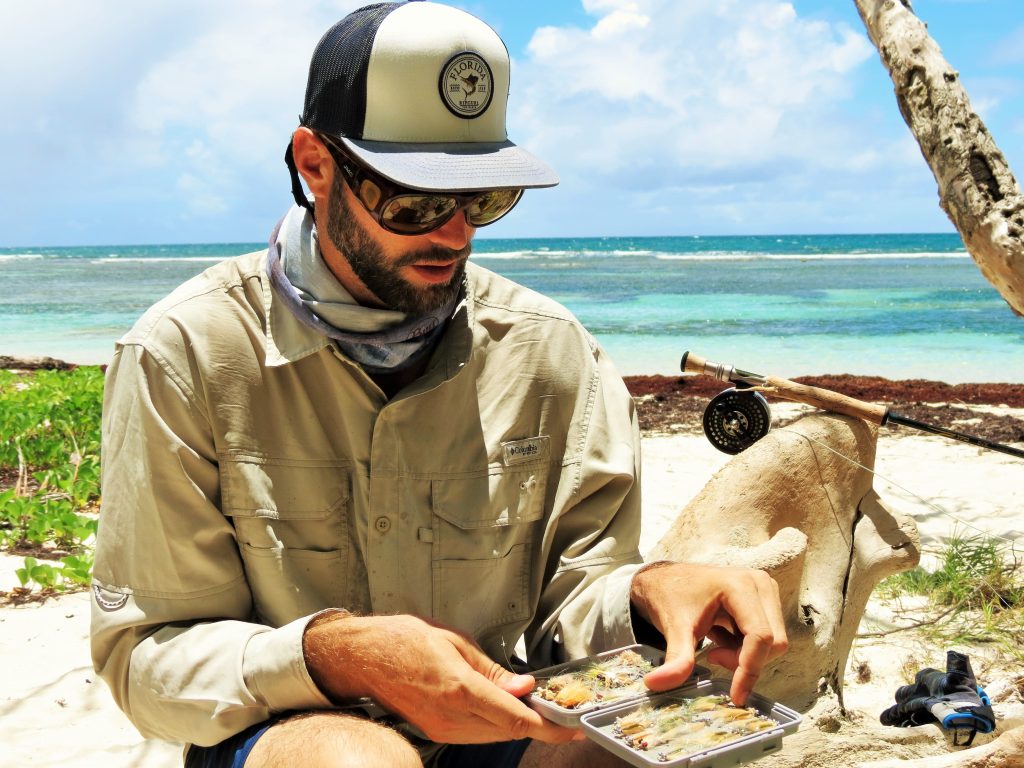
Those who know me will know that I’ve caught, and had caught, many of bonefish with a shrimp imitation resembling to the simple and renowned « Gotcha ». It’s effective, very easy to tie and can be used in many circumstances.
However, I’ve evolved since my early days and now like to use other flies depending on the conditions.
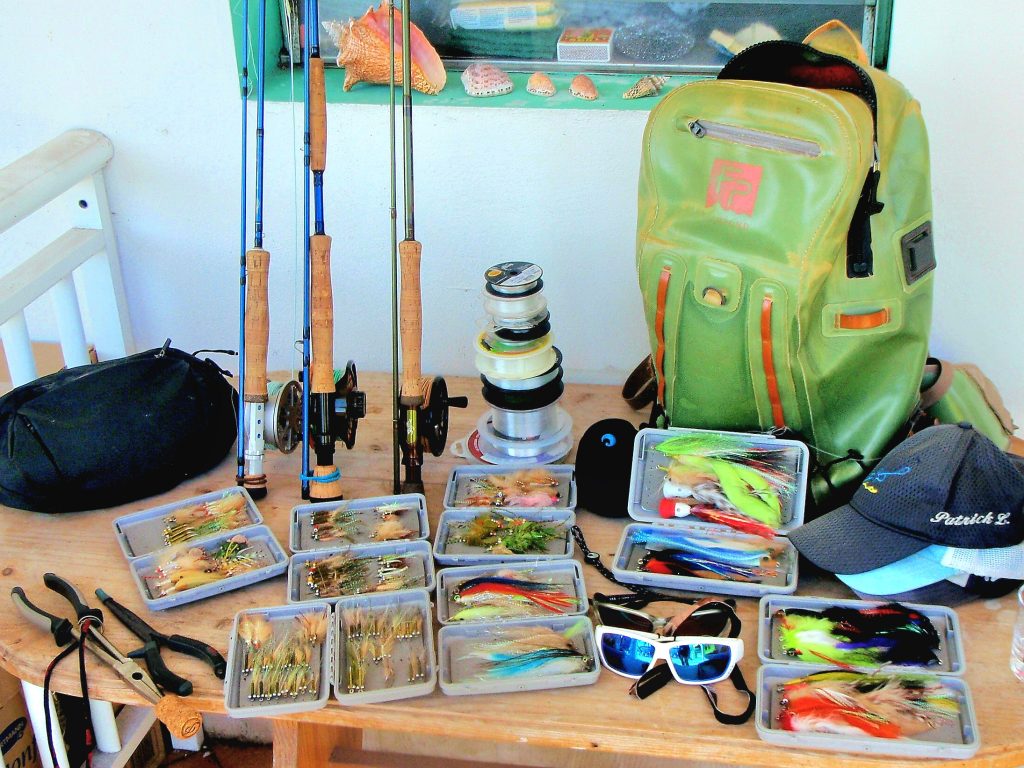
I pay particular attention to the swim, weight, brightness, size and strength of the hook. When I’m asked about the best flies for fishing in Guadeloupe, my answer is this : select the best-known flies such as Crazy Charlie, Gotcha or Flexo Crab. Keep only strong iron hooks, and vary the weights for each of your flies. Hook sizes between 2 and 6 are often used for large bones. Vary the length and color of your flies. Fish are sometimes attracted by small appetizers, while at other times they’ll go for a heartier dish ! The most popular colors are olive, beige, pink and white or transparent.
Around forty flies in a box is a good number to cope with any situation. When you’re just starting out on the flats, there’s a lot to lose. Even more so if you give in to the temptation to fish the water (which I never recommend, as it will scare away the bones you won’t always see, and thus greatly reduce your chances of catching them), in which case the little barracudas with their sharp teeth will steal some of your flies. It would be a shame to find the right pattern (combination of size, color, weight), and only have one left…
In my opinion, the most important thing, even with the best flies in the world, is to master ALL the parameters…
The right presentation of your fly is crucial ! Don’t worry, I explain very clearly to my anglers how I proceed at the beginning of each day so that all you have to worry about is casting towards the bones when the time comes !
Equipment :
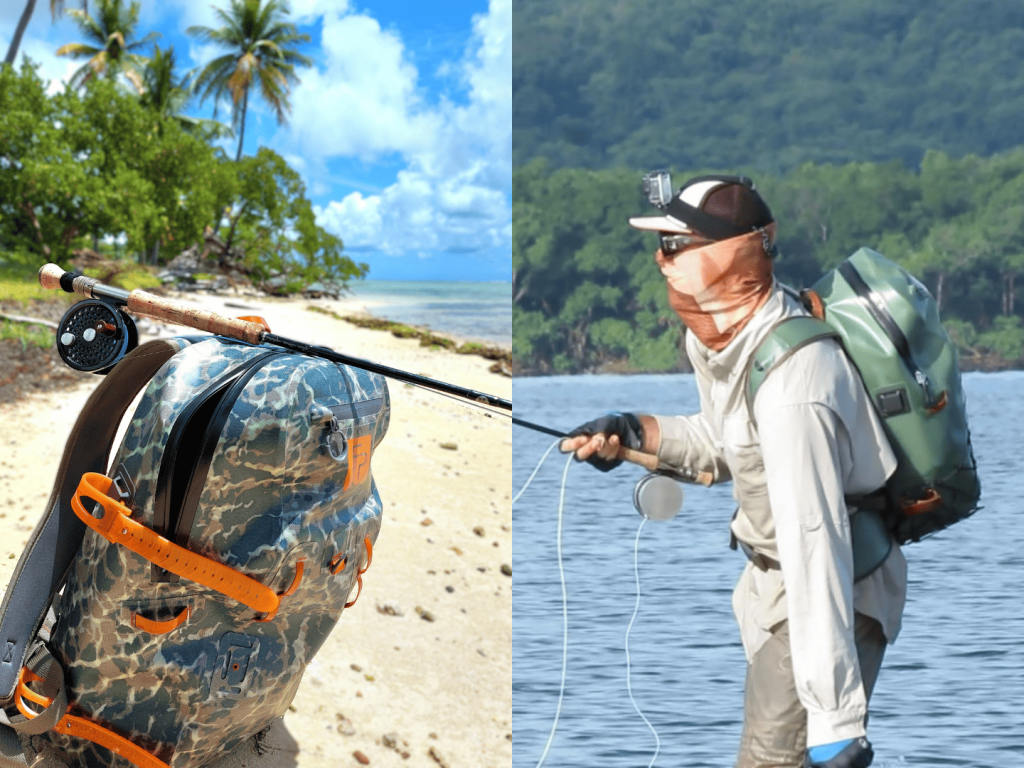
Appropriate clothing will protect you from the sun for several days on the flats, and save you a visit to… the chemist ! As we say here in Guadeloupe, there are 2 things to protect yourself from above all else : rum… and the sun! Light, quick-drying pants, a long-sleeved shirt in a neutral color (avoid flashy colors), a cap, a neck warmer, gloves, a pair of light wading shoes and, above all, a pair of excellent polarized sunglasses. I like to use brown lenses (amber – bronze or copper) when the light is strong and yellowish when it’s cloudy. I don’t recommend lenses that are too dark/black or too saturated in hues such as very light green or bright yellow, as the contrast between the fish and the background may not be sufficiently marked. A waterproof bag can be useful to protect your flies, leaders, pliers and camera.
Conclusion :
Sight fishing for bonefish in Guadeloupe is rightly reputed to be difficult. Most of the world’s experienced bonefish anglers use experienced guides. So there’s no reason not to do the same here. DIY (Do It Yourself) fishing for this fish here in Guadeloupe requires a great deal of local experience. For my part, I can help you make rapid progress and put you in a catching situation, even if you’re a beginner fly fisher.
This type of fishing is therefore accessible to all, with the right accompaniment.
Although this article may enlighten some of you on bonefishing in Guadeloupean waters, it is no less true that many elements such as the ability to see the fish, make the right fly choices, the ability to correctly set your drag, or even the interpretation of weather conditions will most certainly take you many days of fishing before becoming truly « efficient ».
The guide will undoubtedly save you precious time. I’ll put you in the best conditions to increase the number of fish you see, and therefore your chances of catching them. As you will no doubt have understood, conditions here are very changeable and strategic choices, or even small details, often make all the difference.
Contact me for more information on my services, I’ll be delighted to answer all your questions and do my utmost to offer you the most beautiful fishing memories on the « Island of beautiful waters », here in Guadeloupe !