


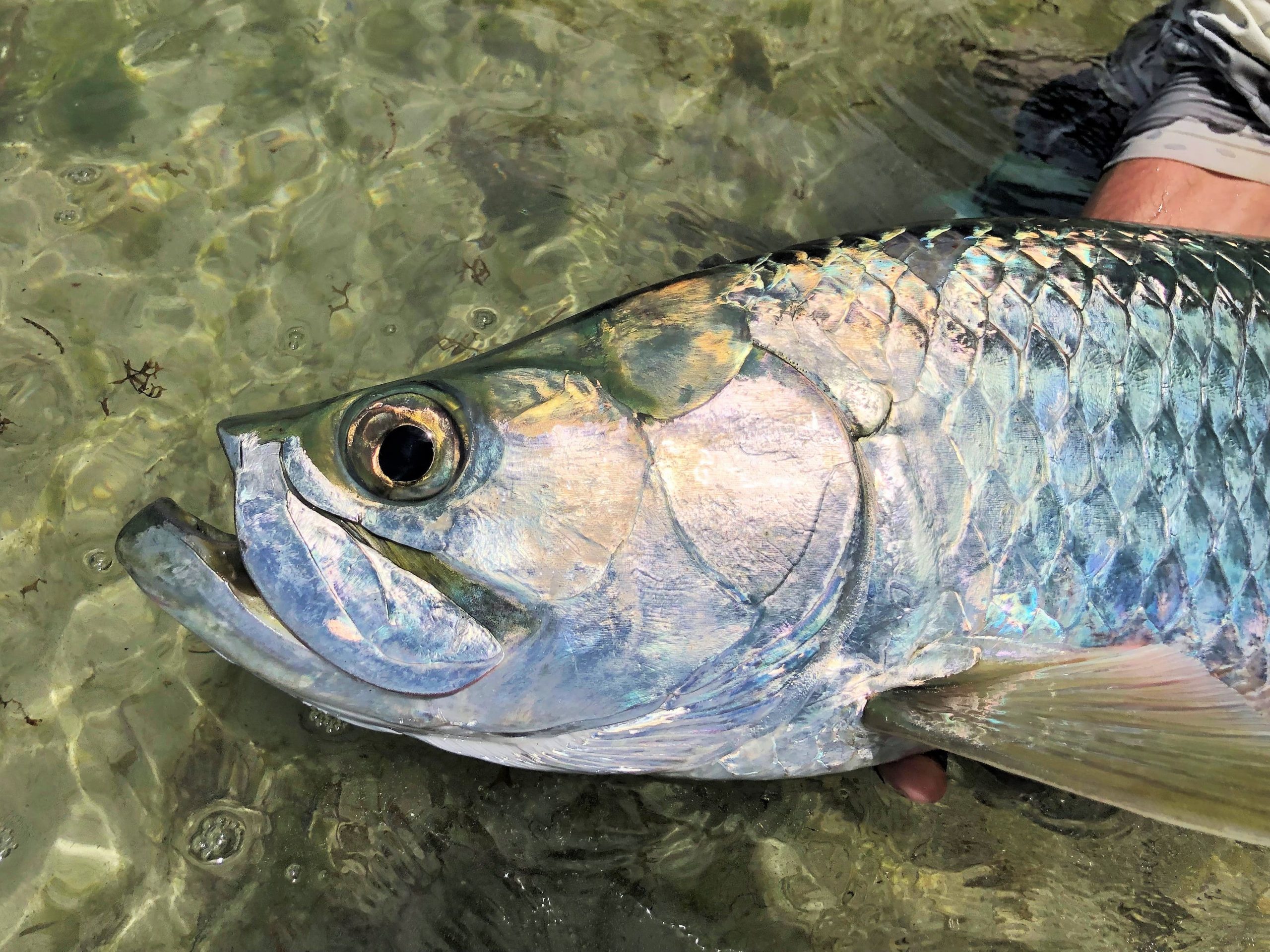
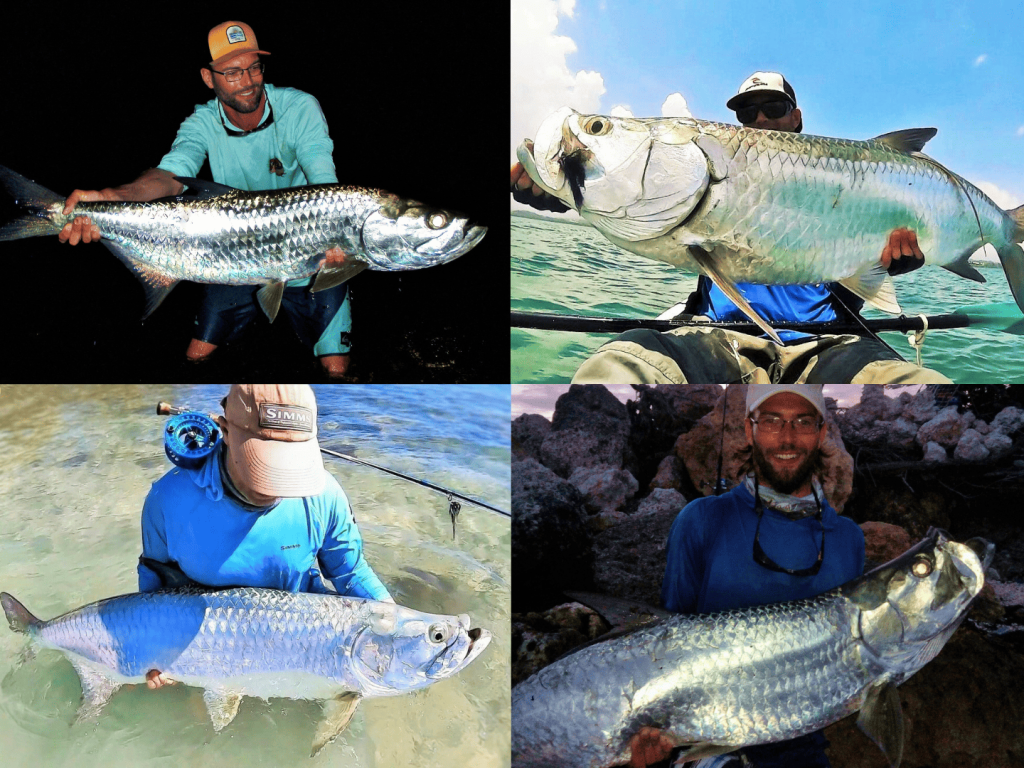
A dream fish, the tarpon, also known as the « silver king », has been haunting Guadeloupe’s warm waters since time immemorial. The Arawak Indians, the island’s first inhabitants, must surely have fished for tarpon and other mangrove fish.
A prehistoric looking, a real sport fish, the beauty of its large silvery scales is matched only by its ferocity in battle.
Some of you may wonder whether it’s even possible for them to catch one, so many of them have been unhooked or broken, without ever managing to finish a fight. Others are already addicted to this fish after only catching their first tarpon. You may even be one of those anglers who simply dreams of having even the opportunity to catch one. Then this is the destination for you. I don’t know of any place as accessible as Guadeloupe, from every point of view, to hope to meet this magnificient fish ! That said, many factors will determine whether or not you succeed in catching one…

Thanks to the experience I’ve gained over 11 years of intensive fishing here in Guadeloupe, and exclusively with lures (never trolling or baiting) and flies, I’ll try to give you the basic tips and best practices to fish sportingly this fabulous species.
TARPON BIOLOGY AND HABITS :
The Atlantic Ocean tarpon « Megalops Atlanticus » can live for more than 50 years, measure over 2m50 (8 ft) and weigh over 100kg (220 pounds). It is found in the Caribbean and on the West African coast, as well as in recent years in the Pacific on the west coasts of Panama and Costa Rica (thanks to the Panama Canal, opened in 1914). It is therefore the same genetic strain throughout the Caribbean. First of all, we need to distinguish juvenile tarpons from adult tarpons. We call them « baby tarpons », up to around 1m20 (47 inches).
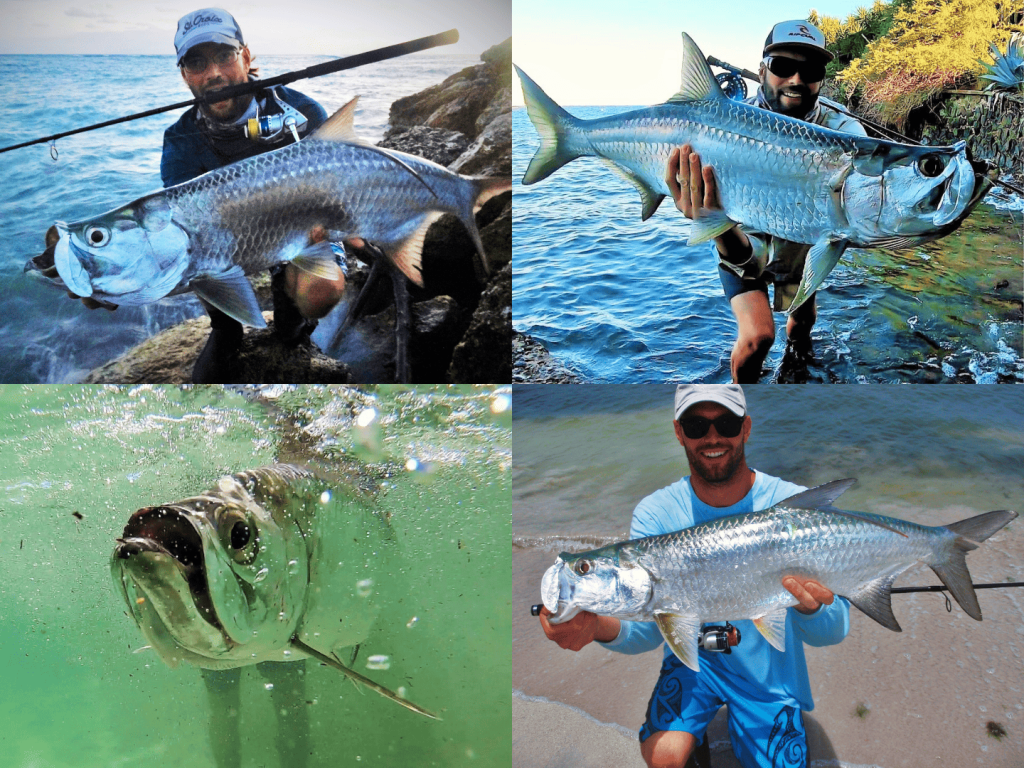
This corresponds roughly to the size required for sexual maturity. According to American scientific studies, female tarpons reproduce for the first time between 1m10 and 1m40 (43 to 55 inches), and males from 1m05 (41inches). They reproduce very late. It takes 8 to 10 years before the species can start reproducing for the very first time in its life. They are also capable of traveling several hundred miles to breed in the open sea.

Baby-tarpons are mainly found in mangrove swamps, channels and even seaside salt ponds. Close to the submerged roots of mangrove trees, they are sheltered from predators such as sharks (in the mangrove, mainly Carcharhinus limbatus) and barracudas. To find them in good numbers, it’s a good idea to go fishing in these brackish waters after the rain. The sediment mixes with the clear water, and the whole food chain comes to life. From zooplankton and small crustaceans to carnivorous fish. Even if it’s possible to catch them without heavy rain, it’s at this precise moment that baby-tarpon feeding activity is most significant.
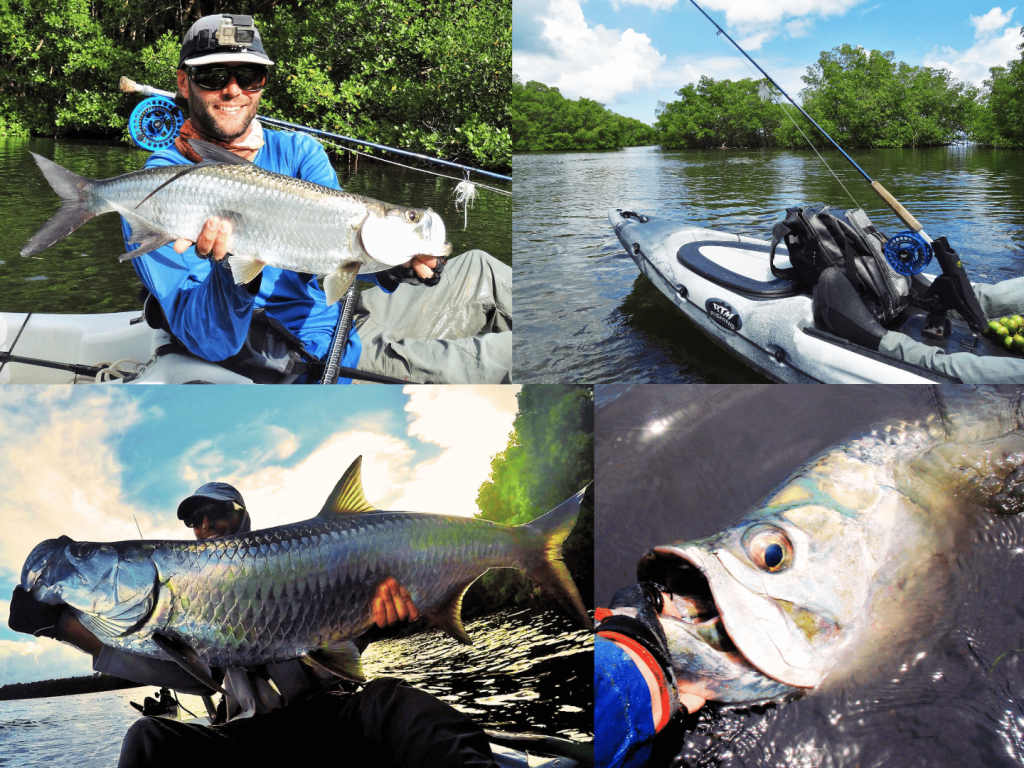
Larger specimens are more likely to be found at sea or in bays open to the sea. Baby tarpons and tarpons have more or less the same habits and behavior in the wild. There’s nothing particularly distinctive about their feeding habits. Except that in the sea, tarpons are more interested in finding large schools of bait fish, while baby-tarpons are more opportunistic and will attack small fish, crustaceans, insects, depending on the day…
Both feed on relatively small prey that they can pick up on the bottom, in suspension or on the surface. Lures and flies imitating small fish, with Creole names such as « caillis » (small sardines no bigger than 10cm-3,94inches), « piscettes » or other « balaous » and « canifices » (small species of garfish) or even crab or shrimp imitations are used.
Getting to know the behavior of baby tarpon is an enriching step towards effective fishing of larger specimens.
Babies are quicker on the attack than their heavier elders. Flies and lures often need to be animated faster than for adults. Imitations must be adapted to the waters you fish, in terms of weight, depth, current speed and water color. As a general rule, we use more natural colors (white, beige, blue, black, red, purple…) in clear water, and flashier ones (light green, pink or fluorescent colors) in tinted water. When the water is very murky, the fish won’t see your lures, so give priority to the sound and vibrations emitted over the colors …
STALKING :
In certain situations, we can fish tarpon 100% on sight, which is terribly thrilling !
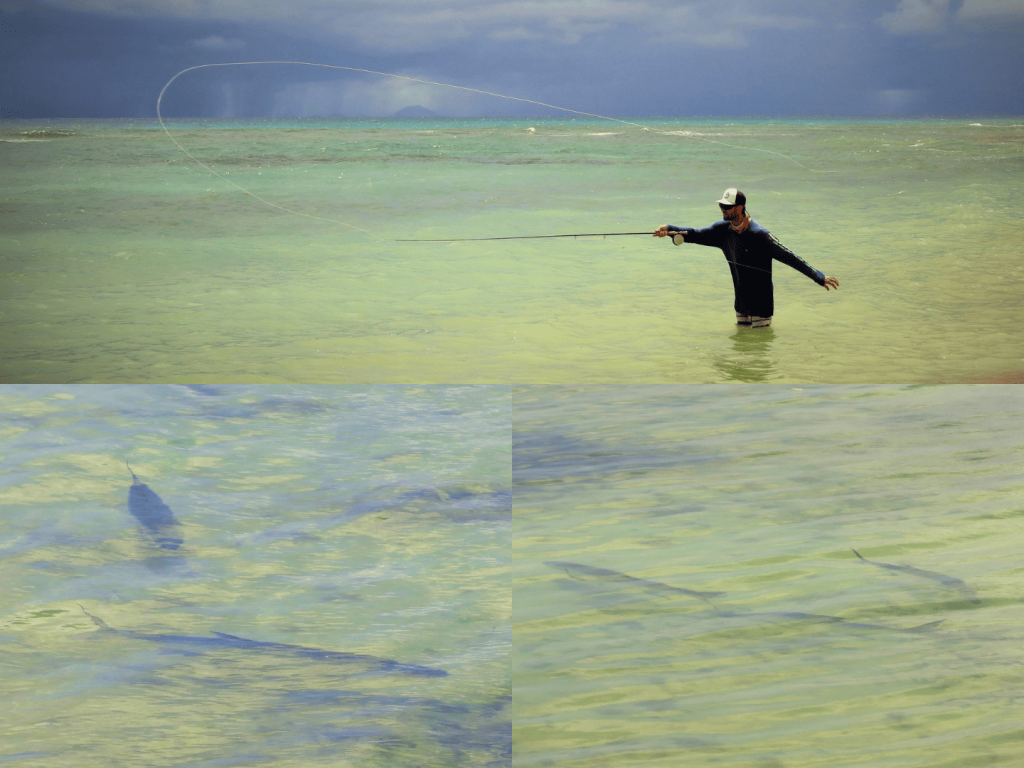
Anticipate its trajectory and swimming speed and place your fly or lure in the fish’s cone-shaped field of vision. Leave at least one rod length between the fish’s head and your lure. If the fish moves towards your fly, it means he’s seen it and your presentation is good. If they refuse immediately, it’s often because your fly doesn’t suit them, or because they’ve sensed your presence. Otherwise, let him come quietly to it, and animate slowly. His reaction will reveal whether you have the right set, or whether you need to animate faster or not… Although done in larger depths, the presentation is similar to the one we try to practice with bonefish.
In all environments favored by tarpon, scanning the surface is often the best way to locate them. In fact, tarpon “roll” on the surface, like a salmon. This reveals their presence. There are several reasons for this attitude. In addition to their gills, tarpons have the ability to breathe ambient air through their mouths. This enables them to live in waters with very little oxygen. They also roll to look at what’s going on above the surface. So be discreet when you’re approaching them. It can also be a sign of emerging feeding activity.
From late winter to late summer, large schools of sardines are present at the coast. So it’s interesting to know what these “balls of baits” look like, which can be confused by novices as seaweed or reflections. You sometimes see tarpon rolling in those schools and you tell yourself that the choice of fly or the presentation won’t matter. All you have to do is put your fly in the water and one of them will catch it. Sometimes this is the case, but on other occasions, even after dozens of casts, nothing happens. The secret lies, among other things, in the presentation and timing of your casts, which means favouring the surprise effect instead of overfishing a sector, and finding the right depth and swimming speed for your lure. A lure that swims slowly and between 2 waters will often distinguish itself. You should always ask yourself why the fish would take your imitation over thousands of beautiful, real, live prey… Also beware of rolling tarpon, they are not always the most “biting” fish, the real hunting action may happen a few meters away…
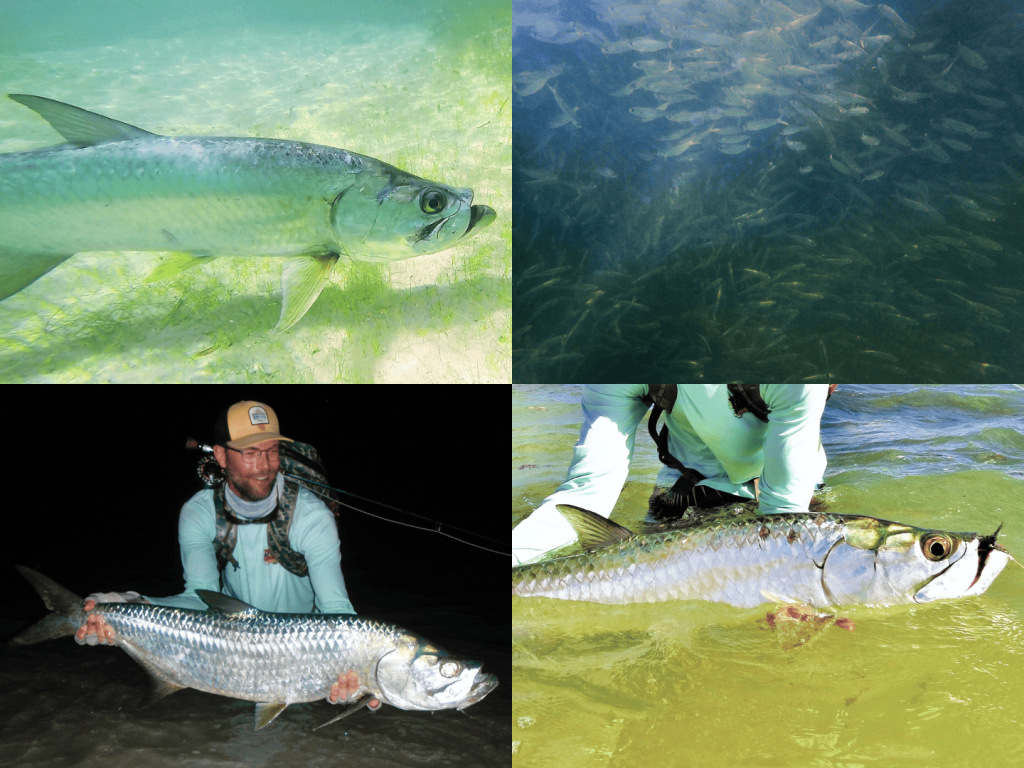
LEARN TO READ THE FEEDING ACTIVITY OF TARPONS.
When visibility is good, there’s nothing like interpreting the behavior of schools of sardines. The movement of prey in more or less tightly packed schools is highly indicative of the action which is about to happen ! This is how an angler will find himself correctly positioned or not, even before the hunt begins.
If you’re curious, patient and very attentive, with time you’ll be able to decode all these subtleties and understand when the tarpons really plan to hunt… This way, you’ll cast less often, and therefore reduce the risk of frightening the school, for example by the repeated impact of your lure on the surface, or making your line cross with the sights of a tarpon… You’ll inevitably increase your chances of catch. These surface activities are a bonus for the angler. This game of reading schools of baitfish can also be valid for trevally fishing. This is not applicable to all species. The snook, for example, whose behaviour is somewhat similar to that of the zander in freshwater, lives pretty close to the bottom and in water that is often tinted, so it won’t reveal its intentions as much… Even if other aspects reveal the presence of snook, that’s another question… (See the corresponding article!).
AN EXTRAORDINARY BITE :
When discovering tarpon fishing, you might imagine that this fish, with its reputation of some of the most powerful, will systematically rip your rod or line out of your hands on the strike… In fact, the tarpon is capable of delivering a bite from another planet ! Such is the case when it grabs the fly or lure and turns on it itself.

But they can also produce what I call a “roach fish bite”, especially on very large fish ! And for good reason, tarpon can eat a passing prey, without aspiration, and sometimes even moving towards you, creating a “slack” in the line… Very large snook (over a metre) are also capable of producing this kind of bite, but the tarpon’s prognathic , bony jaw makes it particularly difficult to feel anything in this situation. Only experienced tarpon anglers can feel this kind of bite and hook these fish at the right time ! This inevitably increases the number of big tarpon hooked… Surprising as it may seem, many anglers (even experts on other species) have expressed to me their scepticism about the possibility of a bite. However, it’s easy to find proof that the lure was in its mouth. Look at the first few inches of the leader – they’re rasped almost every time !

Once the tarpon has grabbed your lure, the game is not over…
In the shortest possible time, strike hard ! The hook must be set into the extremely hard, bony mouth of the tarpon. As if you were trying to set a hook in a rock ! If you’re not under tension and in immediate contact with the fish, it will reject your lure or fly in a fraction of a second. You often have to cast a lot… before you manage to hook the first one properly. Practising on baby-tarpons, because there are more of them, helps you to progress more quickly on this type of exercise. After this, the fish will begin a highly explosive first rush !
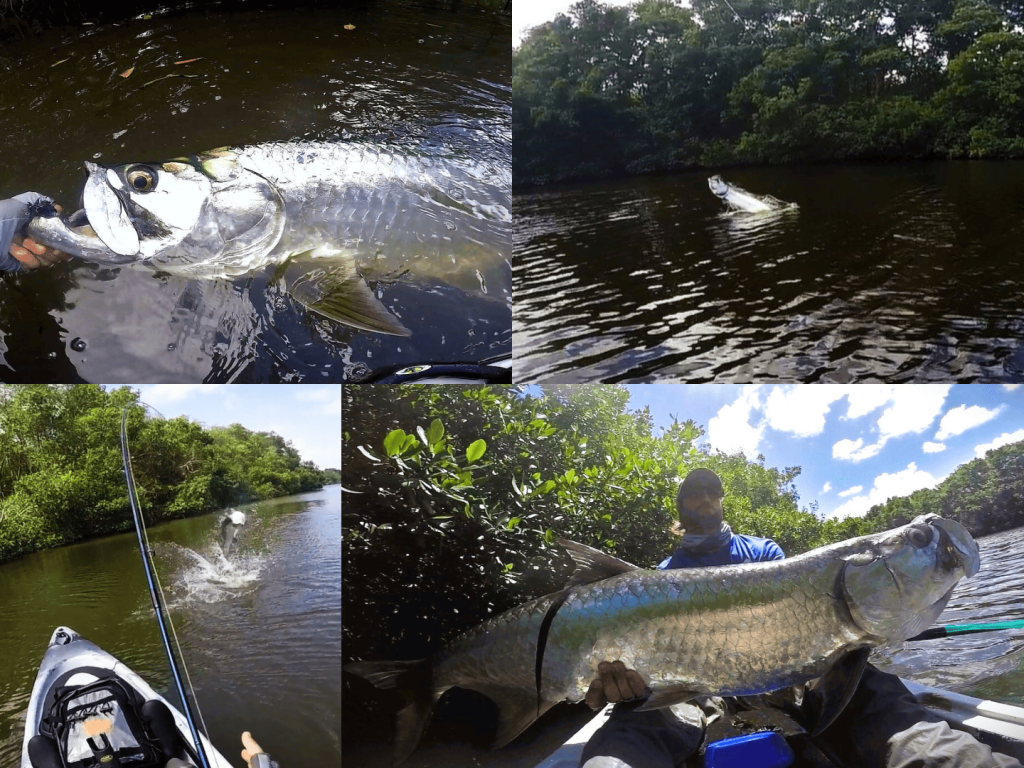
You need to fight this one with the rod as low as possible from the surface of the water. This way you will limit pulling its head skywards, which would make it jump out of the water more every time, and increase the chances of losing the fish. Now you know how to film tarpon jumped scenes 😉
Knowing how to adjust your brake to the size of the specimens you’re after is a fundamental asset. If your drag is too tight, the tarpon will be forced to jump, because it will be difficult for them to swim horizontally. And if your drag is too loose, the tarpon may not be hooked as it should be when fishing with a lure. Moreover, it might empty your reel spool until it finds the first obstacle.
Let me remind you that the famous but very real postulate of catching only 1 tarpon out of every 10 fish hooked is not just fantasy ! It’s true ! It’s an average, so some will be lucky enough to finish the fight on the first tarpon bite, whereas it may take another 10 to 15 bites to repeat the achievement. Experienced tarpon anglers reduce this average to 1 fish out of 4-5 strikes.
It’s true that it can be a little frustrating! But isn’t the game worth the effort ? To see a 100 pounds tarpon take your fly from your feet, run away at incredible speed and “satellite” itself in the air several times, is a spectacle that leaves the most jaded of anglers speechless! I can guarantee it !
The right equipment for tarpon fishing in Guadeloupe :
1 – FLY FISHING EQUIPMENT:
– Rod for baby tarpon :
A 9 feet rod 9 line weight is generally suitable for fishing baby tarpon (up to 1m20-47inches). Remember that in certain stretches of mangrove connected to the sea, when you’re in the presence of 60 to 80cm babytarpons (24 to 32 inches), for example, it’s not out of the question that a bigger tarpon or a 90/100cm (35 to 40 inches) snook (also a magnificent and very powerful fish that shouldn’t be lost) will also succumb to your snacks.
– Rod for tarpon + 1m20 – 47 inches (personal record of 1m65 – 65 inches on the fly):
Appropriate, solid equipment is a must. A 9 ft fly rod with at minimum a #10 or even an #11/12 is required for large tarpon.
– The reel :
As my father (also a professional fishing guide) often says : “You catch a fish with your rod, and you lose it with your reel” ! A reel with a strong, durable drag is a must ! If you have no trouble getting the line out by hand with the drag set to maximum, it’s just not made for these fish. For tarpon between 1m20 and 1m50 – 47 to 60 inches (the most common size of large tarpon in Guadeloupe), I advise you to equip your reel for 10 or more line, with at least 200-250 meters (650 to 820 feet) of backing. Although not very common in Guadeloupe, subjects over 1m80 – 5,9 feet can easily attain this distance in fight.
– Lines :
Floating line is almost always recommended, with the option of adding a leadcore or polyleader between the tip of the line and the leader when you want to fish deeper. It can be interesting to have another line of intermediate type when the surface activity is less, the wind intensifies or it comes from the front.
– Leaders :
A whole range of leaders is required. Nylon, monofilament or fluoro, transparent, avoid coloured threads. Personally, I carry sections ranging from 50 to 100 hundredths, in order to offer the right diameter, i.e. sufficiently discreet yet robust, depending on the size of the specimens in front of me. With experience, you’ll know which diameter to choose for each situation. A length of 1m50 – 60 inches may be sufficient for babytarpons and 2m30 to 3 meters (90 to 118 inches) for big tarpon.
– Flies :
The 4 main criteria are size, weight and/or fiber absorption or floatability, color and hook resistance.
For adult tarpon, streamer or clouser type flies of 10 to 12cm are most commonly used, and for babys, clousers of 5 to 8cm (1,97 to 3,15 inches). Poppers, which are less often used at the end of the line, can also be very effective. In all cases, use ultra-strong iron hooks !
2 – LURE FISHING EQUIPMENT :
– Rods :
To fish baby tarpons, rods between 2m20 and 2m50 (7,2 ft to 8,20 ft) with a power of 10-40 grams to 15-60 grams (0.35/1.41oz to 0.53/2.12oz) will do the job.
For tarpon of 1m20 – 47 inches and over (for info. personal record in Guadeloupe of 1m70 – 66,93inches on a spinning) a rod of at least 2m40 – 7,87 ft up to 3 metres – 9,84 ft will be ideal for the shore, and of power between 20-80 grams and + 100gr. (0.70/2.82oz to +3,53oz).
– Reels :
A spinning reel in size 3000 – 3500 will do the job for babytarpons up to 1m-1m10 (39-43 inches).
A reel in size 4000/5000 with a solid drag may be appropriate for small tarpon as well as tarpon up to about 1m40 – 55 inches. A 6000 will be more robust and suitable if you only target fish between 1m20 – 1m50 (47 to 59 inches) and over, or even a “4500 SW” reel (stronger than basic reels and designed for more salt resistance).
– Braid :
Fill your spool completely with braid.
A 20 hundredth braid is appropriate for baby tarpons. 15 hundredths is a minimum if you’re in an environment where larger subjects can potentially be found (up to 80/90cm – 31,5/35,43 inches). I’m not talking about ponds where you’ll only find babys of 50cm – 20 inches maximum, where a 10 hundredths braid is sufficient.
For tarpon of 1m20/1m50+ (47/59 inches), a 30 hundredths braid is ideal to cast far enough when necessary and at the same time to be able to bridle large fish.
– Leaders :
From 50 to 100 hundredths, passing through at least every tenth depending on the size of the fish. A length of 1 metre (39 inches) will be sufficient in mangroves for babytarpons. 1.50 to 2 metres (59 to 78 inches) for tarpon longer than 1.20 metres – 47 inches.
– Lures :
For babytarpons, all hard « seabass » lures can be effective, from poppers to jerkbaits, not forgetting the many soft lures such as “shads”, “slugs” or other “creatures”.
Vary the colors as explained above to match the different shades of water.
Stock your tackle boxes with floating, sub-surface, suspending and sinking surface lures.
For hard lures, suspending lures of around 3,94 inches, with or without bib (depending on whether seaweed is around or not) with a solid full-wire armature will be ideal in many situations for large tarpons.
Use only « strong iron » hooks. For those who are new to exo-tropical fishing, « strong iron » means that when you try to twist the hook, the iron moves very little, or at best not at all. Only then can you say that the hook is suitable for tarpon fishing. For example, a « seabass » or « pike » hook will only resist opening on specimens not exceeding 80 centimetres – 31,5 inches (as a general rule). Don’t expect to catch a tarpon over 1m10-1m20 (43-47 inches) with this type of hook. It only happens by chance.
Do not use coastlock snapes most commercially available snaps risk opening during the fight. A good connecting knot is all you need.
Now you’re ready to catch the legendary « Silver King » ! (Don’t be afraid to call in an experienced fishing guide ! He’ll put you in the best possible conditions to make your dream come true).