


Until now, few anglers have taken the time to catch permit on fly in Guadeloupe. However, this “French” territory offers a unique playground for the conquest of this Holy Grail,
so FLY FISHING PERMIT IN GUADELOUPE, SIMPLE UTOPIA OR FISHING TRUTH ?
Coming from a family of fishermen, life miraculously brought me to live this extraordinary day : the capture of a very large permit on fly ! For me, this capture sounds like the ultimate reward for my passion as a fisherman and my work here as a guide (since 2016).
Guiding on waters that have already proved their worth on tropical species (bonefish, tarpon, snook, trevally…) known to the general public is a challenge, because the expectation is often there ! Meeting the challenge of catching, or bringing people to catch the ultimate grail of all fly fishers is something different…
Whether we want it or not, in fishing, sharing is part of the very essence of our sport. But with no specific informations or advices on permit fly fishing in the West Indies, I had to learn almost every piece of the puzzle on my own. My apprenticeship took several years. Certain encounters, such as those with experienced flats fishermen and even internationally renowned guides, were very helpful.
By dint of perseverance, determination and time, the necessary elements slowly began to take form in my mind…
ITS ENVIRONMENT
First of all, the islands of Guadeloupe are only 1702 km2 (about the size of a French department), with 630 km of coastline (including protected areas). This is a far cry from the vast expanses of flats in the Florida Keys, Belize or Mexico, or the 4,000 cays and islets of Cuba… Permit fishing in Guadeloupe is therefore comparable to nowhere else in the world.
At first view, this small Caribbean archipelago doesn’t seem to be the place on the planet that lends itself best to permit stalking. And yet, in my humble experience, I can assure you that the world record is swimming in our waters !
Many small coral flats dot the coast here. Most of them consist of a flat area covered with turtle grass, with a few sandy holes appearing here and there. This is the ideal ground for sight-fishing for bonefish, for example.
Outside these flat areas, a “coral reef” forms. This is marked by the waves that submerge it. At first view, these areas are difficult to explore on foot, as the ground appears to be hardly practicable.
But by walking close to these natural obstacles, much appreciated by our dear permits, observing them and moving around them, I’ve learned to spot all the areas where a potential fight could possibly take place, without having to walk on the fragile (to be preserved !) and salient corals.
In Guadeloupe, it’s possible to attack each week one or several permits weighing over 10 kilos “on sight”, and dream of the ultimate Grail in “French waters”.
In fact, I regularly see some real “giants”, well over 10kg, and for the biggest, even close to 20 kilos (40 pounds) ! If I summarise in a few figures the number of “pretty” (from 3 kilos upwards) permits seen daily, I’d say that I attack 3 to 5 fish per 7 hours day when I’m specifically looking for them. In other words, when the weather and fishing conditions are unfavorable (but still fishable !), I generally see 1 to 3 permits that are more or less “attackable”. On really good days, I’ve come across up to a dozen “roundwings”, as they’re called here. A few rarer times, I’ve also encountered real “schools” of several individuals …
That’s what happened to me when I took my last personal record of around ten pounds.
As you can imagine, weather conditions of one week rarely look like those of the next. What turns in favor of fishermen or doesn’t… (This is also true in all regions and destinations around the globe) ! And here, the weather is very variable, from one day to the next, and sometimes even from one hour to the next… So the important thing is to adapt in real time.
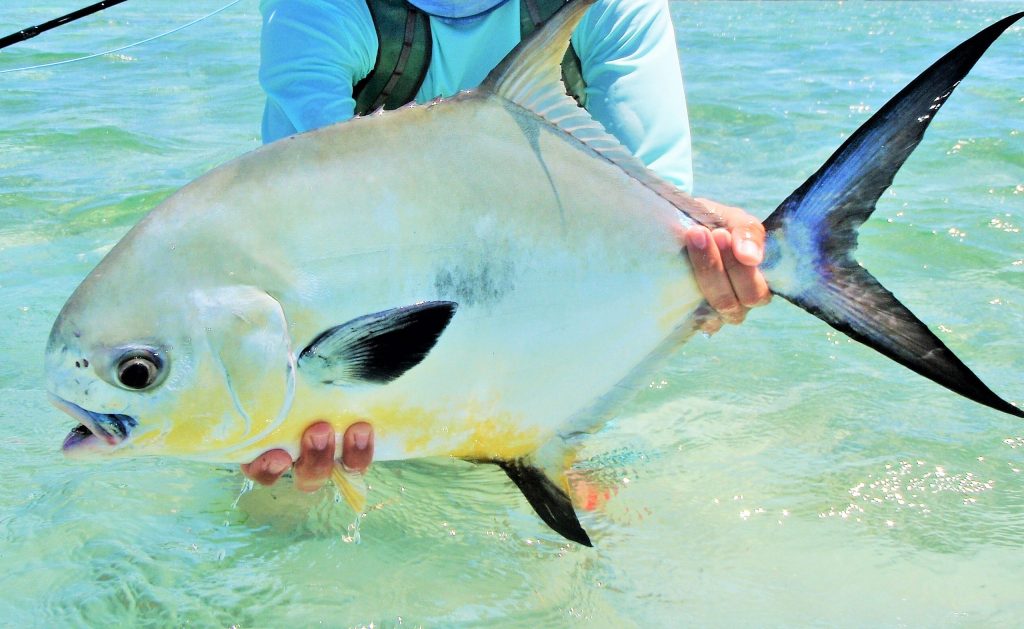
My first real Guadeloupean permit (early 2023) “on sight” on a fly !
These figures show that the chances of landing a trophy permit on your first day of fishing in Guadeloupe are very slim. If you really want to increase your chances of catching one, I’d say that an “accompanied” stay of at least a few days (the more, the better !) is much preferable, bearing in mind that with permit fishing, not catching one is the rule, the norm, and catching one the exception…!
When bonefishing, we also frequently see schools of 5 to 15 small fish weighing a few hundred grams. Less experienced, they are more accessible. That said, it’s funny to see how reluctant these little permits are to take even a perfectly presented fly… It’s nothing to say how spooky this species can be.
ITS STALKING
The approach I use, specifically on sight, only on fly and wading, allows us to blend perfectly into the feeding grounds of the permits. On foot, we are almost invisible and inaudible. It’s probably the best way to approach them discreetly, and what’s more, it’s a very pleasant approach with your feet in warm water !
Well-known to trachinotus anglers, permit can be found on shallow flats, but they also cruise in search of food at deeper depths. So they can be found in a wide variety of environments…! I’m finding them more and more often in areas where I’d never have thought of fishing them before…
That’s why I decided, on this day when there wasn’t much to fish on shallow flats, to look for permit elsewhere than on a conventional flat. That day, I only saw 2 permits. This one + another of comparable size swimming with it. Contrary to what you might think from the pictures, conditions at the start of the day weren’t all that favorable ! Windy, cloudy conditions reduced visibility to just a few dozen minutes during this several-hour fishing session.
Then came that moment I’ve experienced dozens of times before, and which can be paralyzing if you’re not sufficiently prepared. Seeing your dream in front of you is destabilizing, I grant you…
These 2 monsters pass me at a distance of 10 meters (30 feet)… Then they speed away ! At that point, I had to try my luck, whatever the cost. On the first cast, I almost scared them off by landing too close to them, but fortunately it was too short and they didn’t perceive anything. The 2nd cast was the right one ! I put my fly correctly in front of them, some fifteen meters (50 feet) from where I was standing. I could see immediately that the first one was moving straight for it. I’ve experienced this scene several times and know that until the fly is seriously grabbed and anchored, it’s all over…
To my amazement, I see this permit eat my fly in its run-up, just under the surface ! Inevitably, a major obstacle is just a few meters away… My lucky star of the day, he goes the other way !!! A series of rushes follow, which I take in tense on my rod. He seems to know every obstacle in the area ! I feel I’m doing the right thing, even if I’m not at all relaxed, almost certain I’m fighting with the fish of my life ! I bridle him as much as I can and let him take some line when I have no other choice, otherwise I’m risking breakage !
At some moments, I’m walking in the water, almost to the point of having no feet at all, and sometimes I’m moving ahead of him… or backwards ?! My line rubs against one last obstacle, and I’m up to my neck in water. I finally make my way back to shore, slowly, metre after metre, continuing to pray that my set will not break… Despite two unsuccessful tries in which the fish swims away again, I finally arrive by beaching it on the sand. The fight seemed never-ending ! And yet I have experienced big fights lasting several hours in my life… My friend who was there immortalized the scene by filming and taking pictures. The camera only showed 12 minutes of fighting. I can’t believe it ! My dream is here, in my hands !
I’ll spare you the details, but the least we can say is that the planets aligned !
It’s hard to explain all the elements that led me to this moment, but here are a few to keep in mind :
When you’re looking for permit on fly, there are no “typical days”. Of course, sunny days are best. Sometimes you need to spot permits while tailing when visibility is less good or even poor. At other times, you can simply spot them swimming underwater.
It’s the sum of several factors and precise parameters that will determine whether or not you’ll find them at the coast. The tide, of course, affects the height of the water, and therefore favors their presence on one flat rather than another. Wind direction and speed will also increase or decrease the height of water in a given area.
Here, permits often prospect for food relatively quickly. Generally quicker than bonefishes. The time to attack them is therefore shorter than for our dear bones. You also need to be able to put your fly down quickly and, above all, discreetly at any distance, regardless of the wind direction. Sometimes we have to attack them with a strong head or side wind… To foil their mythical visual acuity, long leaders are needed with sometimes quite heavy flies, which doesn’t make casting any easier ! The flies that really take permit are also very varied and you need to stick exactly to what they’re looking for if you want to avoid refusals, which, to be honest, are the norm with this species.
As with any difficult fish, it is essential to concentrate all your energy on tracking it. Target only this species, often to the detriment of the pleasure of other catches. You need to accumulate as much informations as possible in order to reduce uncertainty as much as possible, even if it remains omnipresent. The more you encounter, the more likely you are to get them to bite. And in a place like Guadeloupe, I have to admit that you have to have strong nerves to be able to meet the challenge of one of the most elusive fish in existence.
THE BIG FISH
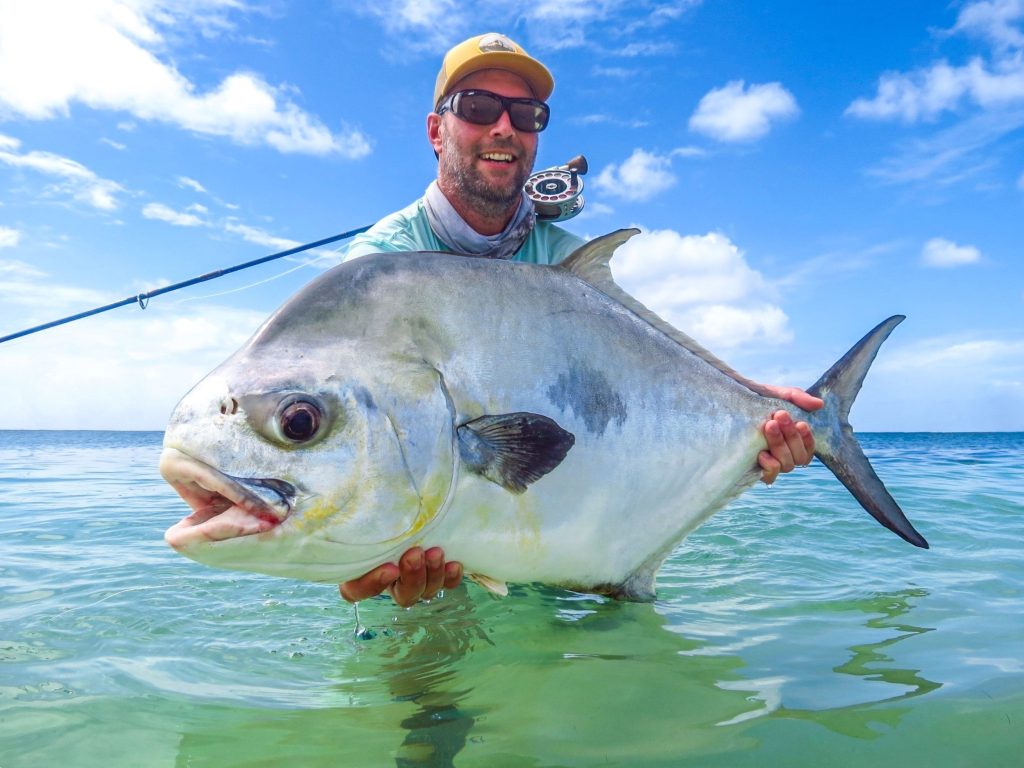
After discovering this archipelago in 2012, which I clearly fell in love with, I never stopped trying to progress in sport fish fishing. After winning 2 Grand Slams, among others, my dearest wish was to take a trophy permit.
Over the past few seasons, I’ve focused a lot on this species, and despite the size of the challenge, I haven’t given up, and now, in 2025, Mother Nature has granted my dearest wish : this magnificent permit, estimated at around 15 kilos (30 pounds), on the fly, on foot and on sight on a flat in Guadeloupe !
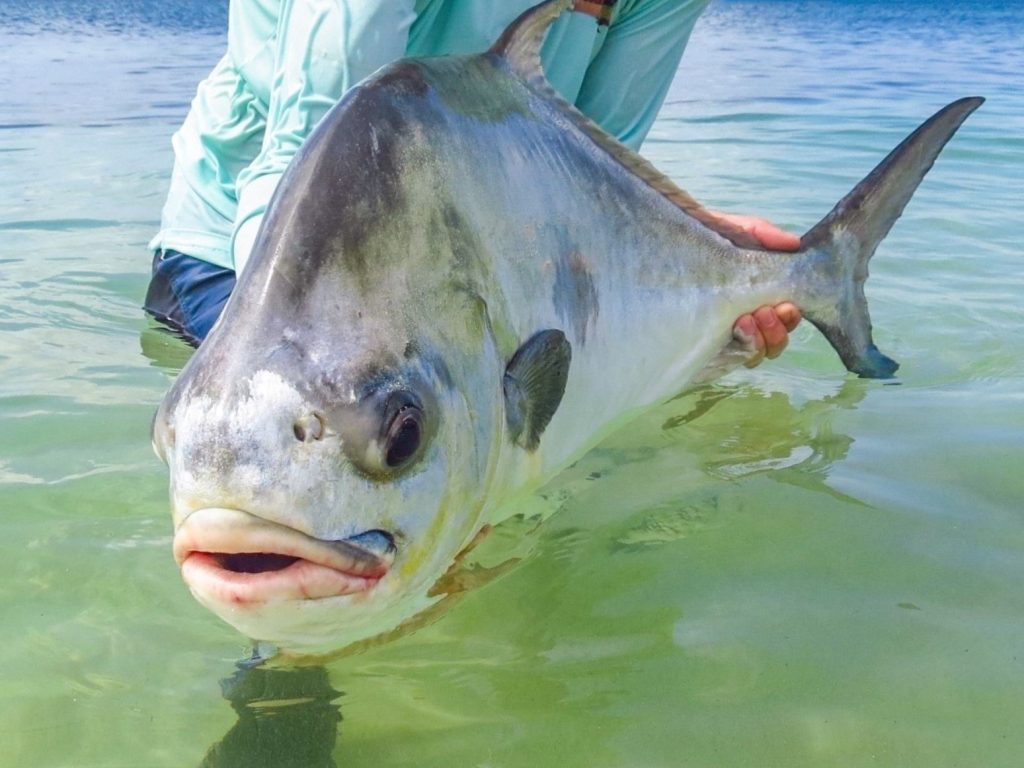
In admiration at my dream !
It takes luck to achieve such a “ feat ”. Nevertheless, I can confidently state that without extensive local experience, the chances of ever holding this legendary fish in your hands are almost non-existent.
Over the past decade, I’ve honed my bonefish technique to the point where I’m catching big fish on a regular basis. During these days of sight-fishing, gradually extending my prospecting zones, I was seeing more and more permits.
Several breaks on beautiful specimens and my very first capture of a 5-6 kilo permit helped me in my evolution. Like many people, I started by catching small specimens. But every permit I managed to get my fly to bite was an incomparable learning experience ! The advantage and the big difference now is that when I come across this great sport fish, I have a better understanding of what it is likely to like… So I use several types of lines, vary the lengths and diameters of leaders, test different types of flies from one situation to another…
I’ve also learned a lot by fishing for the other species I’m passionate about here, namely bonefish (which are most similar to permit fishing), snook, tarpon and trevally. 4 species that also require a serious knowledge of fishing ! It’s surely also thanks to the diversity of approaches required to find these fabulous sport fish and their specific attitudes that I’ve made so much progress and thus had the immense privilege of catching this permit from another planet…
But above all, only time spent on the water has enabled me to experience this unforgettable moment.
CONCLUSION
For the moment, trophy permit catches in Guadeloupe are still anecdotal, and it’s not yet time to state loud and clear that this superb Caribbean country is the new “Eldorado” of permit fly fishing. Only time will tell…
In any case, I don’t know of any fishing challenge that requires so much personal investment and knowledge, yet at the same time provides so much pleasure… This fishery is quite simply the ultimate challenge for any fly fisherman.

I hope these few lines have made you dream !?!
“A dan dot soley!” (« See you in other suns » in Creol) and happy permit quest to you !!!